Buckeye Lunabotics Team
• I founded the Buckeye Lunabotics Team at Ohio State and competed in the 2024 NASA Lunabotics Challenge. In this competition, teams are challenged to design and operate a proof-of-concept lunar construction robot. Our team won the 1st place Systems Engineering Report Award for a First Year Team at the 2024 UCF Qualifying Competition.• As mechanical team lead, I coordinated the design and manufacturing of robot hardware while training new team members. In the 2023-24 season, I had a primary focus on our dump and mobility subsystems while also significantly contributing to electrical and excavation subsystems. In the 2024-25 season, I had a strong focus on systems engineering, and analytical and kinematic modeling of each major subsystem. To ensure smooth electrical and software integration, I worked closely with our controls team throughout both seasons.
• A standout feature of our robot was its ability to easily traverse simulated lunar soil. I preformed an extensive literature review of extra-terrestrial mobility principles, which translated to design parameters used in our wheel geometry and drivetrain design.

A photo of our robot "Gibbous" on simulated lunar soil. Below is the team's systems engineering report:

A screenshot of the CAD model I created for the dump bed of our 2024 robot. I contributed to CAD for the upper frame, excavator, and mobility subsystems as well.

I prototyped the original design for the robot’s excavator deployment linkage using Legos, and the core geometry remained the same in the final design. Changes were made to the cable used to actuate the linkage to simplify cable routing..
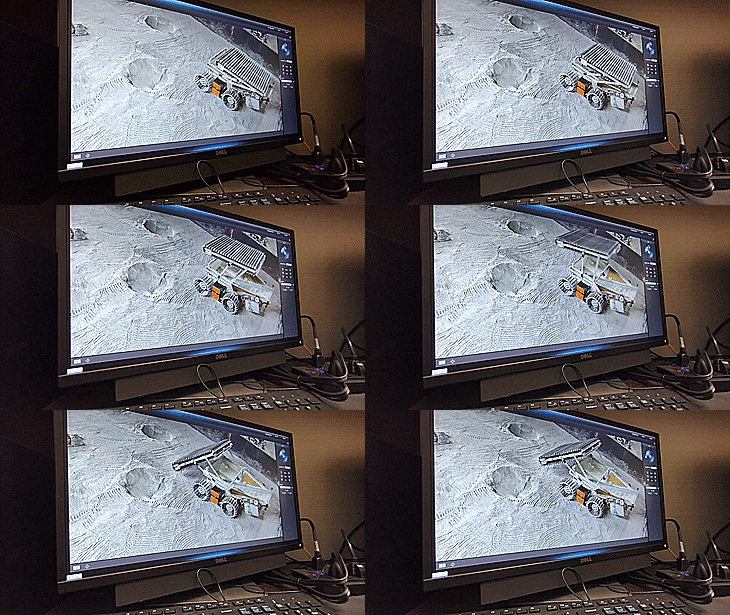
This is how the excavator deployment worked in practice. It was reliable until we lost one of the output gears for the motors while packing, and had to replace it during the competition with a steel-pin reinforced PLA plastic gear.

The gear mentioned above sheared in one match, and we didn’t think we would be able to deploy the excavator. We designed the robot to be balanced when the excavator was deployed, and ended up tipping back onto our electrical box for half the match. Thanks to our drivetrain research and effective wheel geometry, the robot was still able to move, and we managed to use the excavators momentum while driving backwards to achieve a successful deployment!